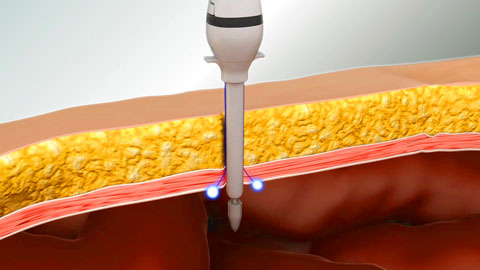
This is where 3D animation becomes especially useful.
Showing the Procedure, Not Just the Product
A medical device is usually only one part of a much larger clinical process. To understand its real value, the viewer often needs to see where the device enters the body, how it is positioned, what anatomy it interacts with and what happens during each stage of the procedure.
With Surgical Animation, companies can visualize an entire clinical workflow in a controlled environment. The animation can move through the anatomy, highlight specific structures, isolate important stages and show the interaction between the device and the body from angles that would be impossible to capture with a camera.
Instead of simply showing a product on a white background, the viewer can understand how the technology is actually used.
Making Complex Technologies Easier to Understand
The more innovative a medical device is, the more explanation it may require.
A new catheter system, implant, minimally invasive instrument or surgical platform may involve several steps that are obvious to the development team but unfamiliar to investors, distributors, sales teams or even clinicians who have not yet worked with the technology.
3D animation allows the story to be simplified without removing the important clinical information.
The viewer can see the device entering the body, follow its movement, understand its mechanism and observe the final result. Elements that are not relevant can be hidden, while the most important part of the technology remains in focus.
This makes it much easier to communicate a complex idea quickly.
Demonstrating How a Medical Device Works
Some products need more than a procedural explanation. The audience may also need to understand the device itself: its components, movement, deployment mechanism or interaction with tissue.
A dedicated Medical Device Animation can show details that are difficult to communicate through photography or live demonstration alone.
The product can be viewed from any angle, separated into components or shown in cross-section. Internal mechanisms can be revealed, and the animation can connect the engineering story of the device with its clinical purpose.
For companies developing technologies that are still in prototype or pre-production stages, this can also make it possible to communicate the product before a final physical version is available.
Supporting Different Audiences With the Same Visual Story
Medical technology companies rarely communicate with only one audience.
Physicians may want to understand the procedure and clinical workflow. Investors may want to understand why the technology is different and where its value lies. Distributors and commercial partners need a clear product story. Sales teams need visual material that can support conversations at conferences and meetings.
A strong 3D animation can become a central communication asset across all of these situations.
The same core animation can be used during presentations, on a website, at exhibitions, in investor meetings and in digital marketing. Different versions can also be created for different audiences while maintaining a consistent visual language.
This helps companies avoid explaining the same complex technology from scratch every time.
Explaining What Cannot Be Filmed
Traditional video is valuable, but it has limitations.
A camera can show the surgeon, the operating room and the equipment, but it cannot always show what is happening inside the body with enough clarity. It may also be difficult to capture a specific procedure in exactly the way needed for a presentation or marketing story.
3D visualization removes many of these limitations.
The animation can move through tissue, make anatomy transparent, zoom into a very small area or pause at a critical moment. It can also show the relationship between the device and surrounding anatomy in a clean, controlled way.
For complex procedures, this can be the difference between an audience simply seeing the technology and actually understanding it.
From Technical Information to a Clear Visual Story
Good medical animation is not simply about creating impressive 3D graphics.
The real challenge is deciding what the audience needs to understand and how to guide them through the information without overwhelming them.
That usually begins with the technical and clinical material: CAD files, drawings, procedure descriptions, medical references and existing presentations. From there, the information can be translated into a visual sequence that focuses on the most important moments.
The final result should feel clear and intuitive, even when the technology behind it is highly complex.
Clear Communication Can Strengthen Medical Innovation
Medical device development requires years of research, engineering and clinical work. But when the time comes to introduce the technology to the market, the ability to explain it clearly becomes just as important.
3D animation gives medical companies a way to make invisible processes visible, show the relationship between a device and the anatomy, and guide the viewer through a procedure step by step.
When people can quickly understand how a technology works and why it matters, the conversation can move beyond technical complexity and focus on its real clinical and commercial value.